
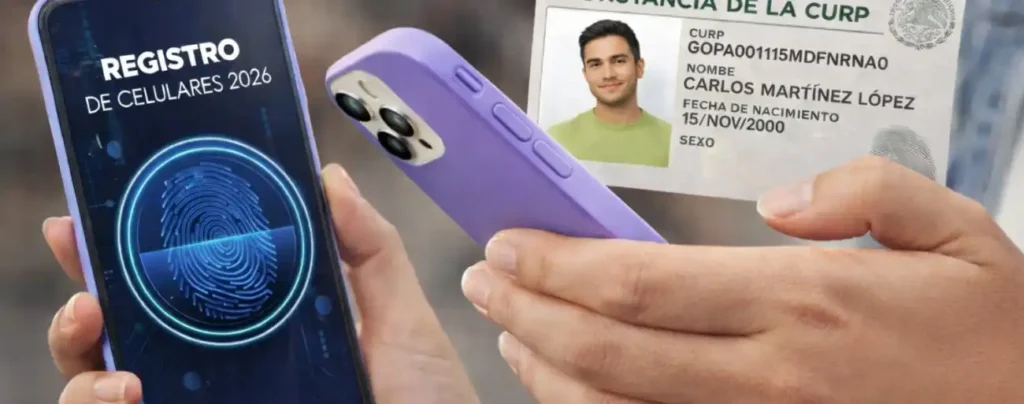
A federal court in Mexico City just cleared the legal path for the country’s mandatory phone registry. An unnamed complainant had obtained a suspension earlier this year, shielding themselves from submitting biometric data to register their number. On March 20, 2026, Mexico City’s 14th Collegiate Court in Administrative Matters of the First Circuit overturned that suspension. The registry is back on track.
Table of Contents
But here’s what almost nobody is telling you: this is Mexico’s third attempt at this exact law. The first ended in a data scandal. The second was struck down by the Supreme Court as unconstitutional. Understanding that history is not just context — for foreign residents and expats wondering what a CURP number in Mexico actually means for their phone, their bank account, and their legal status, it is directly relevant to the decision you are about to make.
Attempt One: RENAUT (2008–2012) — Hacked and Sold for $500
Mexico’s first phone registry, RENAUT, launched in 2008 under a telecommunications law reform. The logic was familiar: link every SIM to a real identity, make criminal use of anonymous lines impossible, reduce extortion and kidnapping. Users had to register their number with their CURP — Mexico’s Unique Population Registry Code, the 18-character ID number that serves as the foundation of legal identity in the country.
The registry collected data on approximately 80 million lines. Then it was hacked. Private data from millions of users was leaked — and allegedly sold by corrupt government officials for as little as $500 USD per database. Instead of helping police catch criminals, the registry became a verified shopping list for the extortionists it was designed to stop. Criminals now had confirmed names and addresses linked to phone numbers.
RENAUT was quietly abandoned by 2012. Phone-based extortion continued to rise.
Attempt Two: PANAUT (2021–2022) — Struck Down as Unconstitutional
In 2021, the Mexican government tried again with PANAUT — the National Registry of Mobile Telephony Users. This version went further, requiring biometric data including fingerprints and facial recognition. Digital rights organization R3D (Red en Defensa de los Derechos Digitales) and others challenged it immediately.
On April 25, 2022, Mexico’s Supreme Court of Justice declared PANAUT unconstitutional in its entirety. The court ruled that it violated the right to privacy because user data would be available to law enforcement without a warrant. It found no adequate limits on when or how authorities could access the data, no time constraints, and no proportionality with less invasive alternatives. The court specifically cited the absence of judicial authorization requirements as incompatible with Mexican constitutional and criminal procedure law.
The same categories of biometric data the Supreme Court found unconstitutional in 2022 are being collected again today. Now they are embedded in a much larger national identity platform with significantly more government access points.
Attempt Three: The 2026 Registry — What Has Actually Changed
The current system launched on January 9, 2026, this time structured differently. Rather than a standalone telecoms registry, phone registration is now integrated into Mexico’s broader mandatory Biometric CURP system. That platform collects face, fingerprint, and iris biometrics and issues a secure plastic ID card. It connects to a Unified Identity Platform linking multiple government databases.
The government’s legal argument has shifted accordingly. The March 2026 court ruling framed the registry as a tool for protecting fundamental rights. The judges cited life, liberty, dignity, identity, and security — with explicit emphasis on locating missing persons. That framing helped the court justify overturning the individual suspension.
What is genuinely different this time: the architecture. The 2026 system is not a standalone database managed by telecoms companies with weak oversight. It sits inside a broader legal identity framework designed to address the exact constitutional weaknesses the Supreme Court identified in PANAUT.
What is not different: the core tension. The same biometric data. The same concentrated government access. The same unanswered questions about data security. And critically — the same track record. In 2025 alone, both AT&T México and Telmex suffered significant data breaches.
The Legal Fight Is Not Over
The March court ruling is important but limited in scope. According to lawyer Armando Pacheco, it does not constitute mandatory precedent and has no general effects across Mexico’s legal system. Other courts can and do reach different conclusions.
Courts in Yucatán, Querétaro, and Mexico City have issued injunctions temporarily suspending enforcement of biometric requirements, citing constitutional and data protection concerns. A federal tribunal in Yucatán specifically suspended biometric data collection tied to the national ID system. That is a direct challenge to the same infrastructure the phone registry depends on.
R3D continues to fight the law actively. Civil society organizations have warned that once biometric identity systems are entrenched, preventing misuse by authorities becomes extremely difficult — a concern that carries particular weight given RENAUT’s history.
For expats and foreign residents, the practical implication is this: legal challenges are ongoing, but betting on their success as a compliance strategy is high-risk. The June 30 deadline is real, the penalties are concrete, and the direction of the courts — as of this ruling — is toward enforcement.
What This Means for You: Compliance Before June 30
Every active mobile line in Mexico — all estimated 137 million of them — must be registered by June 30, 2026. Lines not registered by that date will be suspended on July 1. Calls, texts, and mobile data will stop. Service only resumes upon registration. Lines left inactive long enough may be permanently cancelled.
Your required documents depend on your immigration status. Tourists can register with a passport alone. Temporary and permanent residents must also provide their CURP number. In Mexico, the CURP — Clave Única de Registro de Población — is an 18-character ID code that identifies every legal resident. Think of it as Mexico’s equivalent of a social security number, but required for almost every official interaction in the country. If you are a resident and do not yet have yours, obtaining a CURP in Mexico is now urgent. It is the prerequisite for phone registration and the foundation of your entire legal identity here. See Lorad Law’s complete guide to CURP for foreigners in Mexico if you need to get yours in order.
Online registration requires a live selfie processed biometrically against your submitted ID — the same verification logic that underpins the broader Biometric CURP system. In-person registration at a carrier center is available for those who prefer it.
One warning that cannot be overstated: carriers are sending SMS reminders about registration deadlines. Do not click any links in these messages. Fraud sites mimicking carrier portals are actively targeting users. Always navigate directly to your carrier’s official website.
Make Sure Your Legal Identity Is in Order First
Phone registration is the visible deadline — but it sits on top of a deeper compliance picture. If your CURP is missing, your residency card is expired, or your company’s RFC is not properly linked, you cannot complete registration correctly. Getting every piece of your legal identity in order before June 30 is the real task.
Questions Expats and Foreign Residents Are Asking
Do I need a lawyer to register my phone in Mexico?
The registration itself is straightforward and can be done online or in person at your carrier. What a lawyer helps with is the underlying compliance picture: making sure your CURP number is valid, your residency status is current, and your company’s obligations are met. If any of those pieces are missing, the phone registration is the least of your problems. Our immigration lawyers specialise in exactly this — getting foreign residents fully compliant before deadlines hit.
What happens if I refuse to register on privacy grounds?
Your line will be suspended on July 1, 2026. You can file an amparo — Mexico’s constitutional challenge mechanism — to seek an individual suspension, as the complainant in the March ruling attempted. However, that suspension was overturned. Courts are not consistently granting them, and the legal costs of pursuing one typically outweigh the practical benefit for most residents.
Is my biometric data safe once I register?
The law requires storage in a secure national database managed by RENAPO, governed by Mexico’s data privacy laws. That said, RENAUT’s database was reportedly sold by corrupt officials, and AT&T México and Telmex both suffered breaches in 2025. No centralized database is without risk. What you can control is registering through official channels only — never through SMS links.
I am a tourist. Does this law apply to me?
Yes, if you have an active Mexican SIM. Tourists register with a passport alone — no CURP ID is required for Mexico tourists. If your SIM was activated before January 9, 2026, you must register by June 30. Lines activated after that date must register within 30 days of activation.
My company gives phones to employees in Mexico. What are our legal obligations?
Your company must link the account to its RFC. Each employee’s assigned number must also be linked to their personal ID and CURP. This is a direct corporate legal duty — failure to comply can disrupt operations and create liability. Foreign companies with staff in Mexico should ensure every employee has a valid CURP before the deadline.
Can I use a foreign SIM or eSIM instead of registering a Mexican number?
International eSIMs and foreign SIMs continue to work in Mexico and are not subject to this registry. For short-term visitors this is a practical option. For residents and business owners with Mexican numbers, it is not a substitute — your Mexican lines must be registered regardless.
I do not have a CURP yet. Is there still time to get one before June 30?
Yes, but you need to move now. The biometric CURP process requires an in-person appointment at a RENAPO or Registro Civil module. Wait times are increasing as the deadline approaches. Getting your CURP in order is the foundation for phone registration, banking, property, and immigration compliance in Mexico — it should not be left until the last week of June.
The Bigger Picture for Foreign Residents
Mexico is building an interconnected national identity infrastructure — biometric CURP, phone registry, property and banking verification. The courts are largely backing it, despite unresolved legal challenges at the edges. Each layer depends on the others. Your phone registration requires your CURP number. Your Mexico CURP is now a biometric document. Your banking and property transactions depend on both.
The history of RENAUT and PANAUT does not tell you to refuse compliance. It tells you to comply with full awareness. This system has failed before. Data security risks are real. The legal fight is genuinely ongoing. For foreign residents making long-term decisions about life in Mexico, that context matters — regardless of what any single court ruling says.
The June 30 deadline is less than three months away. The third attempt at this law is moving forward. This is the moment to act — with your eyes open.
Ensure Your Full Legal Compliance in Mexico
The 2026 phone registry is one piece of a complex legal landscape that affects every foreign resident in Mexico. Your CURP, your residency status, your company’s RFC — each one is a dependency in this system. Getting any of them wrong means your phone line is the first thing you lose, not the last.
At Lorad Law, we don’t just explain the rules — we make sure you are fully compliant. From securing your residency and CURP number in Mexico, to forming your company, to closing on your property, we are your dedicated bilingual legal partner in the Riviera Maya.
Don’t let regulatory complexity risk your investment or peace of mind.
Contact Lorad Law today — our bilingual Mexican lawyers are ready to help.