
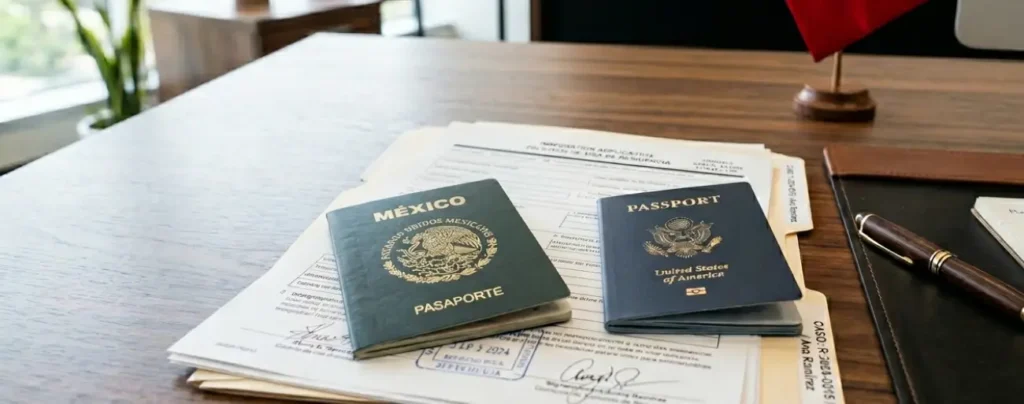
The Trend Is Real. Here’s the Data.
In 2025, Mexican Consulates across the United States saw something unprecedented: applications for Mexican citizenship nearly doubled compared to the prior year. In Laredo, Texas alone, the consulate processed 945 citizenship applications—up from just 482 in 2024. Similar spikes appeared in Houston (151% increase) and Dallas (37.5% increase).
It’s May 2026, and the trend hasn’t slowed. If anything, it’s accelerated.
“It’s like when you buy insurance for your car. You are not thinking you are going to crash,” said Juan Carlos Mendoza, Consul General of Mexico in Laredo, in March 2026. “They are preparing in case they face a situation; if they need to come back to Mexico, they are ready.”
This isn’t about identity. It’s about legal protection, residency optionality, and generational security—and the clock is ticking.
Who Is Actually Getting Mexican Citizenship?
The data reveals a clear profile:
- American-born children of Mexican nationals seeking formalized citizenship
- Dual-citizen adults now securing documentation for their kids
- Second- and third-generation Mexicans reclaiming legal connection to Mexico
- U.S. residents with Mexican-born parents filing for recognition under descent rules
Most applicants aren’t moving to Mexico tomorrow. They’re securing a backup residency and legal status in case circumstances change. Schools, property ownership, emergency access to Mexico—these require formal citizenship or a valid visa.
The Legal Reality: Three Pathways to Mexican Citizenship
Not all citizenship applications are the same. Understanding which pathway applies to you is critical—and mistakes cost time and money.
Pathway 1: Citizenship by Descent (Ius Sanguinis)
Who qualifies: You have at least one Mexican-born parent or grandparent, regardless of where you were born.
Timeline: 4–8 weeks (if documents are clean) Complexity: Moderate—requires certified birth certificates, marriage records, and proof of parental nationality
The Process:
- Gather original or certified copies of birth, marriage, and parental nationality documents
- Have foreign documents officially certified or apostilled
- Submit application at your nearest Mexican Consulate
- Interview (usually brief, sometimes waived)
- Receive Acta de Naturalizacion or citizenship certificate
Common rejection reasons: Missing documents, incomplete chains of custody, clerical errors on original paperwork, or failure to prove continuous Mexican nationality of the parent/grandparent.
For a step-by-step walkthrough of the descent process, see our complete guide to getting Mexican citizenship by descent.
Pathway 2: Naturalization After Residency
Who qualifies: You’ve held temporary or permanent residency (FM2/FM3 or equivalent) for 4+ consecutive years.
Timeline: 6–12 months Complexity: High—requires proof of residency, financial solvency, clean criminal record, Spanish language evaluation
The Process:
- Establish legal residency status in Mexico (temporary or permanent)
- Maintain that residency for 4 consecutive years
- File naturalization petition at Secretaría de Relaciones Exteriores (SRE)
- Submit proof of financial independence and language proficiency
- Pass background check
- Attend interview with immigration authorities
- Receive citizenship decree
Critical timing: Many Americans don’t realize that starting residency in 2026 means you won’t qualify for citizenship until 2030. If political circumstances shift, you could lose the 4-year window.
Pathway 3: Residency-by-Investment (Fast-Track to Citizenship)
Who qualifies: You have capital to invest ($40,000+ in business or real estate).
Timeline: 8–18 months to residency; citizenship after 4 years Complexity: Very high—requires business registration, bank statements, tax returns, legal documentation
The Process:
- Select investment vehicle (business, real estate, or bond)
- Register company and open Mexican bank account
- Make investment deposit
- File temporary residency application through immigration attorney
- Receive temporary residency approval (1–2 years renewable)
- After 4 years of residency, file naturalization petition
- Receive citizenship
Why 2026 Is Your Window: Three Reasons to Act Now
1. Consulate Processing Is Already Strained
The surge in applications means longer wait times at consulates. In mid-2026, typical processing times have extended from 3 weeks to 6–8 weeks. If you file now, you’ll be in the queue before the fall rush hits.
2. Regulatory Uncertainty in the U.S.
Immigration policies continue to shift. Even if you’re not moving, having a second nationality provides legal optionality. Spanish citizenship takes time. Brazilian residency is restrictive. Mexican citizenship by descent is fast, affordable, and available now—but only if you qualify.
3. Your Children’s Eligibility Window
If you have Mexican-born parents or grandparents, your children inherit that eligibility. But once they’re adults, the bureaucratic burden increases. File for them now while documentation is easier to gather from the parent/grandparent generation.
Why are so many Americans making this decision right now? Learn the real reasons behind the 2026 citizenship surge.
Why Descent Wins (If You Qualify)
The three pathways aren’t created equal. Here’s the reality:
By Descent: 4–8 weeks if you have a Mexican parent or grandparent. Requires documentation but no residency, no investment, no waiting years.
By Naturalization: 6–12 months minimum, but only after you’ve lived legally in Mexico for 4+ years. If you haven’t started that clock, you won’t qualify until 2030.
By Investment: 8–18 months to residency, then 4 more years before citizenship. Requires significant capital and ongoing compliance.
The advantage of descent isn’t just speed—it’s accessibility. You don’t need to move. You don’t need capital. You just need to prove the lineage.
Your Next Step: What LORAD Does Differently
If you’re considering Mexican citizenship—whether for yourself, your children, or as a hedge against changing U.S. policy—the process is legally and procedurally complex. You need someone who understands:
- Mexican nationality law (not just immigration)
- Document authentication across jurisdictions
- Consulate-specific procedures (they differ by location)
- Fast-tracking strategies for families with multiple applicants
- Tax implications of dual citizenship for U.S. citizens
This is where LORAD steps in.
Our Immigration Law team has guided hundreds of Americans and their families through citizenship by descent, residency applications, and naturalization. We coordinate directly with Mexican consulates, handle all document verification, manage translations, and ensure your application doesn’t get stuck in bureaucratic limbo.
The cost of getting it wrong? 6–12 months of delays, rejected applications, and regret.
The cost of doing it right? A legal consultation, proper documentation, and citizenship within weeks.
Frequently Asked Questions
Do I have to move to Mexico to get Mexican citizenship?
No. Citizenship by descent is granted while you’re living in the U.S. You file at a consulate in your country of residence, get approved, and only travel to Mexico if and when you choose. Many people get citizenship but never live in Mexico full-time.
My parent is deceased. Can I still qualify?
Yes. Mexican nationality doesn’t expire when someone dies. If your parent was a Mexican citizen, you can still claim that citizenship through descent.
You’ll need their birth certificate, naturalization record, or passport to prove it, but a living parent is not required.
How long does the entire process actually take?
4–8 weeks from application to approval, if your documents are clean and complete. The hidden time comes before filing: gathering documents (2–4 weeks), getting apostilles (1–2 weeks), arranging translations (1–2 weeks).
Many applicants spend 6–10 weeks preparing, then 4–8 weeks waiting. Total: 10–18 weeks if you’re organized.
What if I don’t know where my parent’s birth certificate is?
You request it from the Mexican consulate in your area or directly from the Registro Civil (vital records office) in the Mexican state where they were born.
This can take 2–8 weeks depending on the state and how clearly you know their birth information.
Can I apply for my children at the same time I apply for myself?
Yes. In fact, you should. Each family member files a separate application, but you can submit them together and use shared documents (your parent’s birth certificate, for example). This speeds up processing for children.
Do I need to speak Spanish?
No. The application and interviews are conducted in English at U.S. consulates. Mexico recognizes that U.S. citizens filing for citizenship by descent likely don’t speak Spanish fluently.
What happens if my application is rejected?
Rejections are almost always due to incomplete or invalid documents—not legal disqualification. If the consulate rejects your application, they’ll specify why. You correct the documents and resubmit.
This adds 3–6 months to your timeline, but it’s fixable.
Once I’m approved, do I have to renew my Mexican citizenship?
No. Mexican citizenship is for life. You never lose it (unless you formally renounce it). You’ll want to get a Mexican passport for travel, but that’s separate from citizenship and has its own validity period.
Can I keep my U.S. citizenship if I become a Mexican citizen?
Yes. The U.S. allows dual citizenship. Even if you become a Mexican citizen, you remain a U.S. citizen. Mexico also allows dual citizenship. You can hold both indefinitely without conflict.
If I get Mexican citizenship, do I owe Mexican income taxes?
This depends on where you live and work. If you live in the U.S. and work for a U.S. employer, you owe U.S. taxes.
Mexican citizenship doesn’t automatically trigger Mexican tax liability unless you’re earning income in Mexico or deriving income from Mexican sources. Consult a tax professional for your specific situation.
Is it cheaper to hire an attorney, or should I DIY?
If you have a straightforward case (both parents documented, no name changes, no adoption history), DIY is possible. But most people find that a $300–$500 consultation saves them weeks and prevents rejection.
The consulate doesn’t explain what’s wrong—they just say “incomplete.” An attorney catches problems before you submit.
The surge in Mexican citizenship applications in 2025–2026 isn’t random. It reflects a calculated decision by thousands of Americans and families to secure legal optionality in Mexico. Whether you’re motivated by immigration policy, generational security, business opportunity, or simply peace of mind, the legal pathway exists.
But it requires precision. Your documents must be perfect. Your application must match consulate requirements. Your timeline must account for processing delays.
That’s why families work with immigration attorneys. Not because the law is impossible, but because the details matter—and one mistake costs time.
If you have Mexican heritage, American-born children, or business interests in Mexico, the window to file is now. Consulates are processing applications faster than ever, but that window won’t stay open indefinitely.
Ready to take the next step? Start with a quick eligibility check for citizenship by descent or explore the complete filing process with LORAD below.
Ready to File? Here’s Your Next Step
LORAD’s Immigration team has guided hundreds of Americans through citizenship by descent, naturalization, and residency applications. We handle:
- Document verification and certification
- Consulate filing coordination
- Application review before submission
- Representation at interviews (if required)
- Strategic planning across all three pathways
Contact us today for a consultation. We’ll assess your eligibility, explain your pathway, and walk you through the process step-by-step. No surprises. Just clarity and results.