

What is Biometric CURP and How Does it Work?
Unlike traditional identification, the biometric CURP uses advanced scanning technology to capture your complete physical profile—and it’s completely free. The process is handled by trained Civil Registry personnel with security standards matching electronic passports.
Table of Contents
| What Gets Captured | Details |
|---|---|
| Fingerprints | All 10 from both hands |
| Iris Scans | Both eyes (left and right) |
| Facial Photo | High-resolution image |
| Digital Signature | Encrypted security element |
Once registered, your document includes an electronic signature, photo, and QR code that links directly to your biometric data.
Required Documents for Biometric CURP in Mexico 2026
Show up with these three items—no substitutes:
| Document | Requirement |
|---|---|
| Government-issued ID | Valid, with photo, not expired |
| CURP | Must be certified (uncertified won’t work) |
| Birth Certificate | Original or officially certified copy |
Missing even one? Your appointment gets cancelled.
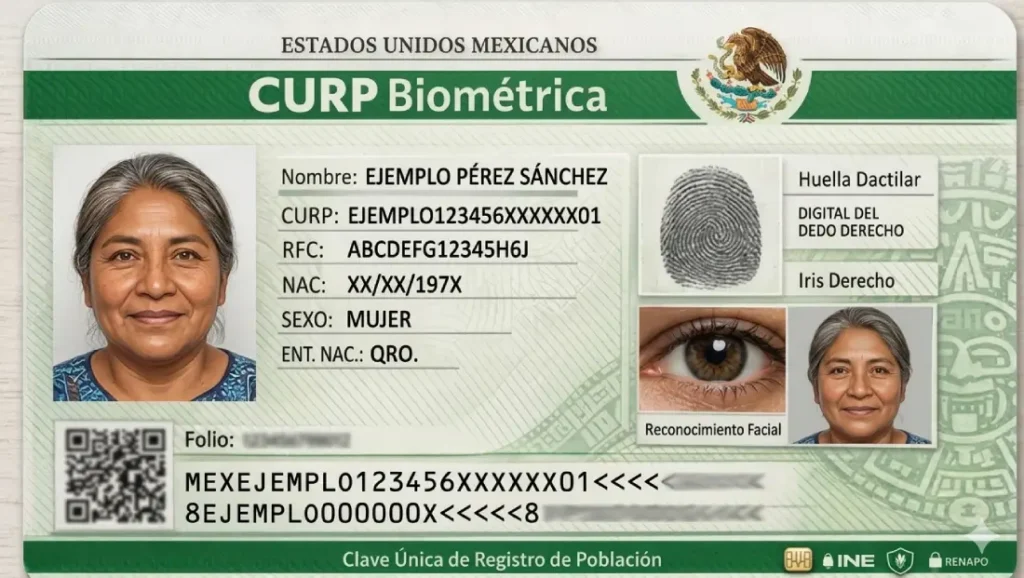
Biometric CURP Data Structure: What Information is Collected
The data structure differs from the traditional CURP. Here’s the exact breakdown:
| Component | Example |
|---|---|
| Paternal surname | First 2 characters |
| Maternal surname | First 1 character |
| First name | First initial (or 2nd if José/María) |
| Birth year | Last 2 digits (e.g., 92 for 1992) |
| Birth month | MM format (01-12) |
| Birth day | DD format (01-31) |
| Sex | M (woman) or H (man) |
| Birth state | 3-letter code |
| Homoclave | 2-3 unique verification digits |
| Renapo certification | Official legend |
| Electronic signature | Encrypted security layer |
| Biometric QR code | Fingerprints + iris data linked |
Why Mexico Implemented Biometric CURP in 2026
President Claudia Sheinbaum’s administration built the biometric CURP as part of the “Unified Identity Platform” to tackle Mexico’s disappearance crisis. The system connects data across Renapo (population registry), National Forensic Database, Attorney General’s Office (FGR), state prosecutors, and National Intelligence Center. Real-time identity verification helps locate missing persons and combat identity theft. It also speeds up transactions with banks and government agencies.
Biometric CURP Requirements for Foreign Investors and Expats in Mexico
The biometric CURP isn’t just bureaucracy—it directly affects your ability to do business in Mexico. Here’s where it intersects with your legal and financial life:
| Situation | Impact of Biometric CURP |
|---|---|
| Opening a business bank account | Banks cross-reference your biometric data for AML compliance |
| Getting a Mexican mortgage | Required for loan qualification and title registration |
| Buying real estate | Needed for Renapo title registration and notarial contracts |
| Paying property taxes | Predial registrations now require certified biometric ID |
| Extending your visa | Immigration uses biometric database for residency verification |
| Applying for permanent residency | Biometric data is part of background verification |
| Registering an RFC (business tax ID) | Hacienda links your business to biometric profile |
| Bidding on government contracts | Many government agencies require biometric verification |
If you’re planning any of these moves in Mexico, your biometric CURP isn’t optional—it’s foundational.
Interactive expat scenarios for biometric CURP
Different goals. Same wall. Biometric CURP is now mandatory.
Where to Get Your Biometric CURP in Quintana Roo
After all, we are Riviera Maya experts, did you think we weren’t going to tell you where you can get your Biometric CURP in this beautiful area of Mexico?
Here are all the official registration offices across Quintana Roo. Click on your municipality below to see the exact address and hours.
Interactive map of biometric CURP locations in Quintana Roo
Cancún
Oficialía 01
Calle Margaritas Núm. 23, Colonia Centro, C.P. 77500
08:30 – 14:00 hrs
Tel: 99-9888-2100 Ext. 7500
Confused or need help getting your Biometric Curp number or affairs in order?
Get Expert Legal Help with Your Biometric CURP Application
The biometric CURP process seems straightforward on paper. In practice, foreigners face delays, rejected documents, and confusion about how it affects their specific legal situation. We’ve seen business owners miss property deadlines, investors get tangled up in compliance issues, and expats discover their CURP isn’t recognized for the transaction they need.
Don’t let that be you.
At Lorad, our immigration and business law team has guided hundreds of foreign nationals through Mexico’s identification and administrative systems. We ensure you have the right documentation, understand the legal implications for your situation, and know exactly what comes next.